
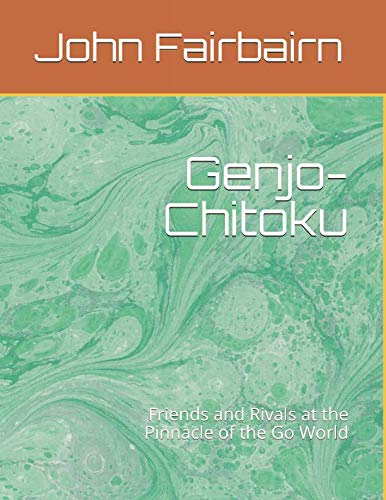
Genjo-Chitoku: Friends and Rivals at the Pinnacle of the Go World
Product details
| Management number | 233625205 | Release Date | 2026/06/27 | List Price | $17.01 | Model Number | 233625205 | ||
|---|---|---|---|---|---|---|---|---|---|
| Category | |||||||||
The Meijin (or Master) has long been the most prestigious title in Japan for the best players of the oriental game of go. Only one Meijin at a time was allowed. Two of the very best players were Honinbo Genjo and Yasui Chitoku. Neither was Meijin. The reason was that they were at their peak in the same era, the early 19th century, which is often referred to as the Golden Age of go in Japan. They were rivals, but were also friends. Many of their games survive and each one is treasured. A major part of the reason is that both had contrasting styles - one favouring early territory then digging in, the other favouring early strength and gaining territory, or reducing the opponent's, by later fighting. This, along with the very high standard of play, has made their games almost a standard text-book for students of the game. The present book collects all their 80-odd games with each other - several being recent finds - and gives detailed commentaries based on a combination of the very many professional commentaries that these games have attracted over two centuries. The historical and biographical background is provided, of course. This is a first, in any language. But traditional commentaries contain a pitfall for amateur students. It is too easy to look at a variation diagram and feel that you have somehow understood. It is like playing games over on a computer screen - click, click, click. Real progress can only come with a slower and more effortful form of study. This book is also an experiment in trying to create that environment.With a view to enabling the reader to think for himself and to read for himself, this book has been designed on the basis of a three-pronged approach. Prong 1 is to encourage the reader actually play over the game on a board. We can call this flow practice – building up the intuition. Prong 2 is to make the reader work out variations for himself. We can call this reading or visualisation practice. This is done either by using letters on the board instead of variation diagrams, or by giving within the commentary some guidance on what the reading should achieve (e.g. it may just say Black does not play this way because White can make a ko in the corner, and if that is deemed a little too difficult to see, we may add something like “He starts with A”). Prong 3 is a major appendix where all the technical words and themes in the book (moyos, ijime, momentum, seri-ai attacks, etc) are discussed and accompanied by memory joggers in the form of proverbs and the like. The idea is not to explain any individual move but to give the reader enough ammunition to think for himself. Hence we can call this creative-thinking practice. Obviously all the examples within the games are cross-referenced with each other, building up a corpus of living examples of each concept. The effect is akin in some respects to training neural networks in artificial intelligence. Although this is all oriented somewhat towards the stronger player, there are plenty of comments for weaker players, too. Both the rich texture of the commentary and the design of the book - with colour coding, cross references and easy-to-read diagrams - add up to make a book where people can, and will want to, go back and re-read once they’ve improved a little and so see even more in each game. Ideally on a real kaya board with slate and shell stones. The book even reveals Genjo's favourite sake, which you can still buy if you wish to really get in the mood! Read more
| ISBN10 | 173128635X |
|---|---|
| ISBN13 | 978-1731286352 |
| Language | English |
| Publisher | Independently published |
| Dimensions | 8.5 x 1.08 x 11 inches |
| Item Weight | 2.86 pounds |
| Print length | 459 pages |
| Publication date | April 8, 2019 |

Bestseller ranking
24" Wiper Blades


Customers who viewed this product also viewed
Board Games


Correction of product information
If you notice any omissions or errors in the product information on this page, please use the correction request form below.
Correction Request Form